
Why We Keep Believing “This Time is Different”
Most bad decisions don’t come from ignoring intelligence. They come from ignoring probabilities we already know deep down.
LIFE LESSONS THROUGH STATISTICS
Vivek Trivedi
5/20/20262 min read
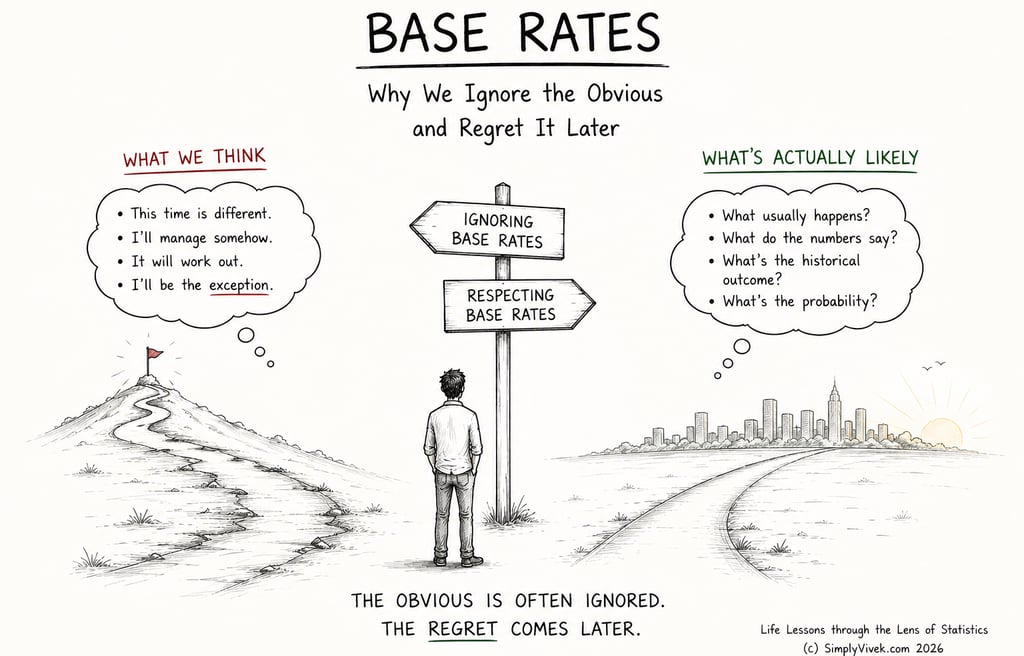
Most regret in life does not come from ignoring complex truths.
It comes from ignoring obvious probabilities.
We often believe:
this time will be different,
I’ll manage somehow,
things will work out because I want them to.
And sometimes they do.
But statistics has a very uncomfortable concept called Base Rates.
A base rate simply means:
What usually happens in situations like this?
Not what you hope will happen.
Not what happened once.
Not the inspirational exception.
Just… what normally happens.
And strangely enough, many bad decisions in life begin when we ignore that simple question.
We do this all the time.
We underestimate how long things will take.
We overestimate how disciplined we’ll suddenly become.
We assume burnout won’t happen to us.
We think our ambitious plan will succeed despite every warning sign.
Why?
Because stories are emotional.
Base rates are boring.
And humans prefer stories.
I’ve noticed this repeatedly in professional life, too.
A transformation project begins.
The confidence is high:
“This team is different.”
“Leadership is aligned.”
“We’ve learned from past mistakes.”
And maybe all of that is true.
But if historically:
similar projects struggled,
timelines slipped,
priorities shifted,
momentum faded…
then the base rate matters.
Not because failure is guaranteed.
But because probabilities deserve respect.
I’ve ignored base rates in my own life more times than I’d like to admit.
Believing I’ll suddenly maintain an extreme routine.
Assuming motivation this time is “different.”
Thinking I can sustainably operate far above my normal baseline.
And when reality eventually catches up, it feels personal.
But often, nothing unusual happened.
I simply ignored the average outcome.
What makes base rates uncomfortable is that they challenge our sense of uniqueness.
We want to believe:
“I’ll be the exception.”
Sometimes we are.
But wise decision-making starts differently.
It starts with:
“What usually happens here?”
And then adjusts intelligently from there.
The interesting thing is:
Base rates are not pessimistic.
They are grounded.
They don’t kill ambition.
They protect ambition from fantasy.
Maybe maturity is not about becoming less optimistic.
Maybe it’s learning to respect probabilities without losing hope.
Before your next big decision, ask yourself:
“Am I building this plan on evidence…
or on the emotional desire to be the exception?”
That question alone can save years.
Learning in public through a small series I’m attempting:
Life Lessons through the Lens of Statistics
Today’s lens: Base Rates - Why We Ignore the Obvious and Regret It Later
#Leadership #DecisionMaking #Statistics #BehavioralFinance #SelfAwareness #MentalModels