Variance: Why the Swings Matter More Than the Average
Two people can have the same average performance and completely different lives. The difference is often not the average. It’s the swings in between.
LIFE LESSONS THROUGH STATISTICS
Vivek Trivedi
5/25/20262 min read
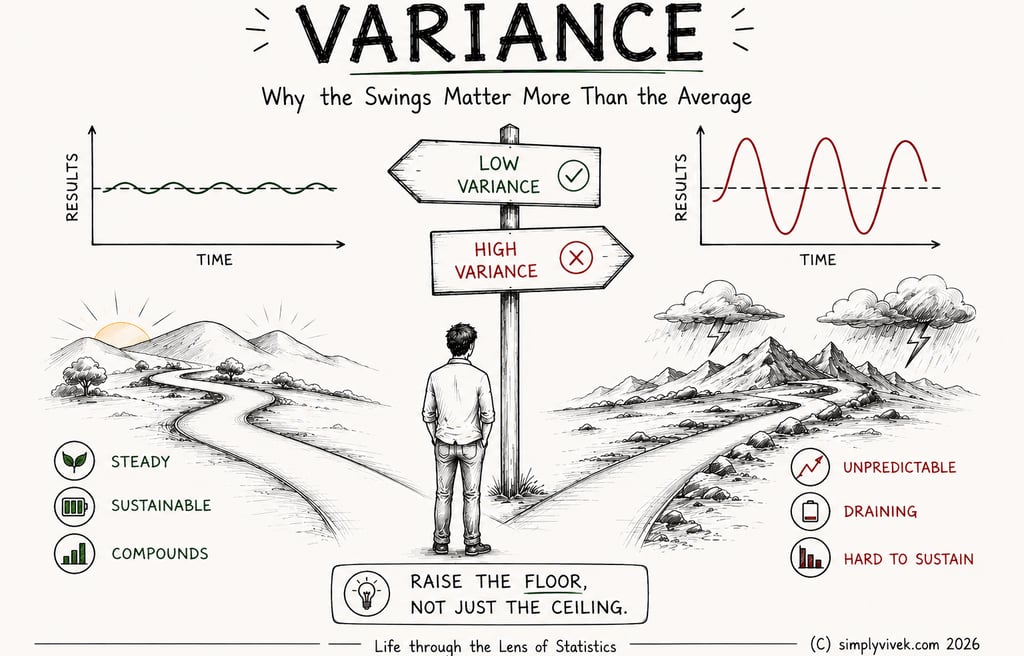
Some people have stable lives with average results.
Others have extraordinary highs…
followed by exhausting lows.
Statistically, both can have the same average.
The difference is called variance.
Variance measures how widely things swing around the average.
Not how high the peaks are.
Not how low the valleys are.
But how unstable the movement is between them.
And strangely enough, this explains a lot about human life.
Most people think they need:
higher performance,
more motivation,
bigger breakthroughs.
But what quietly drains us is often something else entirely:
High variance.
The emotional whiplash.
The constant resetting.
The feeling that some days you’re unstoppable…
and some days you barely recognize yourself.
Investing teaches this lesson beautifully.
Two portfolios can generate the same long-term return.
But one gets there steadily.
The other swings wildly between euphoria and panic.
Mathematically, the averages may look similar.
Emotionally, they are completely different experiences.
And in real life, most people quit the second one long before the averages work in their favor.
That’s the hidden danger of variance - instability changes behavior.
High variance also looks impressive from the outside.
People notice:
explosive gains,
dramatic productivity bursts,
extraordinary effort.
What they don’t see:
recovery crashes,
emotional fatigue,
stress,
inconsistency,
the constant internal negotiation.
Variance creates the illusion of momentum while quietly burning energy underneath.
I’ve noticed this repeatedly in professional life too.
Some teams are extremely capable but wildly inconsistent.
One week, execution is exceptional.
Next, everything slows down.
And management usually responds the same way: “Push harder.”
But pressure often increases instead of reducing it.
Stable systems don’t depend on emotional intensity.
They depend on rhythm.
I used to think discipline meant operating at my absolute best as often as possible.
What I eventually learned, slowly and somewhat painfully, is that real discipline is often about narrowing the range.
Not chasing the highest days.
Not punishing the lowest ones.
But reducing the gap between them.
Life became calmer when I stopped asking:
“How can I perform better?”
And started asking:
“How can I perform more predictably?”
That small shift changed more than I expected.
Low variance doesn’t feel exciting.
There are no dramatic stories.
No emotional highs.
No “grind culture” screenshots.
But almost everything meaningful compounds under low variance:
health,
trust,
reputation,
investing,
skill,
relationships.
Variance burns energy.
Consistency preserves it.
Maybe most people don’t need more intensity.
Maybe they just need fewer swings.
A small takeaway I’m personally trying to apply:
Instead of optimizing for your best days,
start optimizing for your worst days.
Make bad days slightly better.
Make routines easier to restart.
Reduce emotional extremes.
Raise the floor, not just the ceiling.
That’s how systems become sustainable.
A slightly lower average with low variance often beats a high average with chaos.
Because the second one lasts.
What area of life do you think suffers the most from high variance:
career, investing, health, emotions, or relationships?
Learning in public through a small series I’m attempting:
Life Lessons through the Lens of Statistics
Today’s lens: Variance — Why the Swings Matter More Than the Average
#Leadership #Investing #Statistics #BehavioralFinance #SelfAwareness #MentalModels #Consistency