
A Good Decision Can Still Fail
Most people judge decisions by outcomes. Statistics judges them by probabilities.
LIFE LESSONS THROUGH STATISTICS
Vivek Trivedi
6/13/20262 min read
A Good Decision Can Still Fail
And a bad decision can still succeed.
That sounds wrong.
But statistics would agree.
One of the most useful concepts in probability is called 'Expected Value'.
In simple terms:
A decision should be judged by its long-term average outcome, not by what happened once.
Imagine two people.
Person A makes a thoughtful, well-researched decision.
Person B takes a reckless gamble.
This time, Person A loses.
Person B wins.
Who made the better decision?
Most people instinctively choose the winner.
Statistics doesn't.
Expected Value asks a different question:
"If you repeated this decision 100 times, who would come out ahead?"
Suddenly the answer changes.
Life is full of decisions like this.
You can:
prepare thoroughly and still fail an interview,
invest wisely and still lose money temporarily,
make the right career move and still face setbacks,
raise children thoughtfully and still encounter challenges.
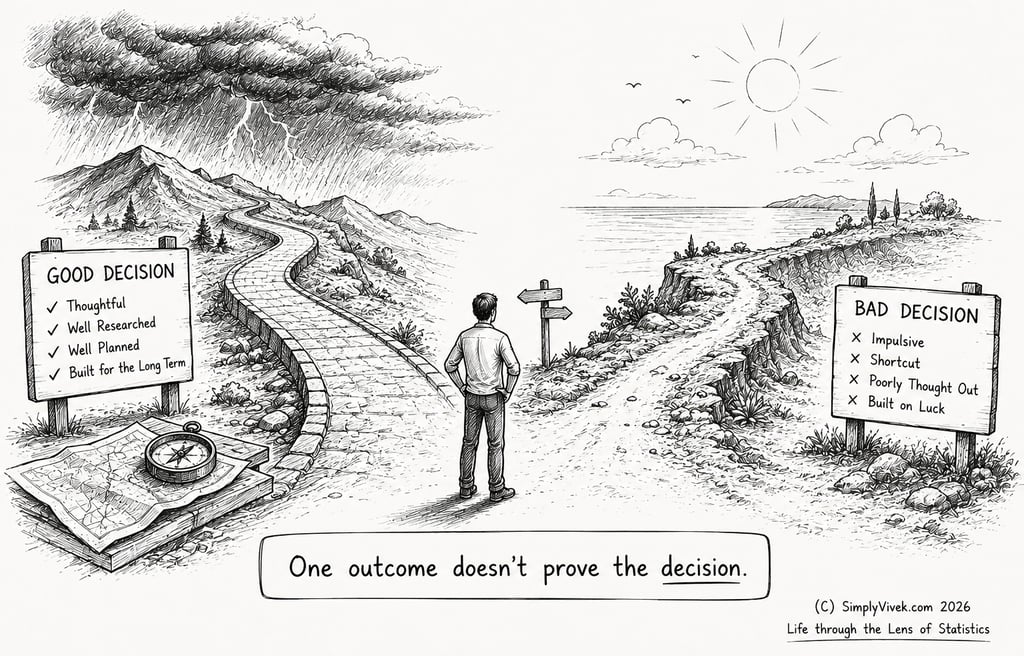
One outcome doesn't invalidate a good process.
Investing teaches this lesson every day.
The best investors know that a good decision can lose money.
And a terrible decision can make money.
At least once.
The danger comes when we confuse the outcome with the quality of the decision.
I've noticed this in professional life too.
A risky shortcut works.
A carefully planned approach faces obstacles.
Suddenly people conclude:
"The shortcut was better."
Maybe.
Or maybe they are judging a single outcome instead of the underlying probabilities.
What fascinates me is how much regret comes from outcome-based thinking.
We replay decisions in our minds and ask:
"Did it work?"
Perhaps a better question is:
"Was it a good decision given what I knew at the time?"
Those are not the same thing.
Expected Value encourages a different mindset.
Stop asking:
"Did I win?"
And start asking:
"Would I make the same decision again under the same circumstances?"
That question is often a better measure of wisdom.
A small experiment:
Think of one decision you regret.
Now remove the outcome.
Imagine you only knew what you knew at that moment.
Would you still have made the same choice?
If the answer is yes, perhaps the decision wasn't bad.
Perhaps the outcome was simply one possible result.
Learning in public through a small series I'm attempting:
Life Lessons through the Lens of Statistics
Today's lens:
Expected Value — Why Outcomes Are Often Terrible Teachers
A good decision can produce a bad outcome.
A bad decision can produce a good outcome.
Judge the process.
Not just the result.
#Statistics #Leadership #DecisionMaking #BehavioralFinance #Investing #LifeLessons #MentalModels